The Sensible Environmentalist
Fighting Fire With Reasoning
 (NAPS)�DEAR DR. MOORE:
Why does each year seem to
bring more devastating forest
fires?
(NAPS)�DEAR DR. MOORE:
Why does each year seem to
bring more devastating forest
fires?
Each fire season
isn�t progressively
worse�last year
almost four million
acres burned compared
to nearly seven
million acres in
2002�but we�re definitely
seeing a
larger number of
more devastating
fires than there were in the past.
Ironically, one reason for this is
the fact that we suppress fires to
protect human lives and property.
Throughout history, fire has
contributed to the health of forest
ecosystems by burning underbrush
and smaller trees and leaving large
trees mostly intact. Today, forests
are surrounded by communities, so
we suppress fire as much as possible.
Unfortunately, this creates an
unnatural build-up of what can
best be described as fuel for fires
that are much, much worse.
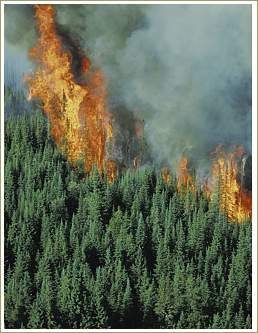
These are the fires that in 2003
killed 28 American firefighters
and destroyed nearly 6,800 homes
and other structures. They burn
hotter and longer, killing countless
animals, polluting the air and
water and leaving the earth effectively
sterilized.
There is a solution, however.
Many forests are overly dense and
therefore prone to catastrophic
fire. By actively managing these
forests�removing dead wood and
thinning undergrowth, for example�
we can reduce this threat.
A good example is the Cone fire,
which burned 2,000 acres of California�s
Lassen National Forest in
September 2002. Of the total area
burned, 1,600 acres were part of
the Blacks Mountain Experimental
Forest, which had been given
to the U.S. Forest Service in 1934
for ecological study. The Cone fire
raged intensely for days, engulfing
everything in its path, until it was
stopped dead by a research plot in
the Blacks Mountain Forest. The
plot had been thinned through
selective logging and burned in a
controlled way to clear the underbrush.
The result was an open forest
that not only stopped the fire,
but looked the same as it did 500
years ago when regular fires swept
through the high, dry country.
As a sensible environmentalist,
I believe that active management
and, specifically, the kind of selective
forestry that stopped the Cone
fire, should be used to prevent catastrophic
wildfires across the U.S.

 home
home