The Sensible Environmentalist
An Antidote To Urban Sprawl
 DEAR DR. MOORE:
How much impact is
urban sprawl having on our
national forests?
DEAR DR. MOORE:
How much impact is
urban sprawl having on our
national forests?
According to the United
Nations Food and Agriculture
Organization (FAO), North
American forests expanded by 10
million acres during the 1990s,
and about two million acres
over the past five
years. This is mainly
the result of advances
in sustainable
forestry and
agriculture. Over
the past 50 years,
we have learned
how to grow more
food on less land,
so we�re actually
farming fewer acres. As a result,
many lands previously cleared for
agriculture have now been reforested.
That�s the good news.
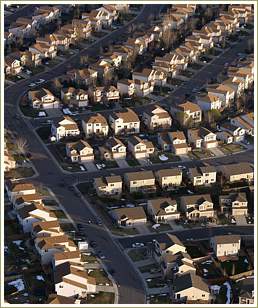
The bad news is that urban
sprawl is indeed a major problem.
We�ve gone from a nation of
farmers to one of subdivisions and
two car garages, where the closest
store is driving distance.
Across the country, new suburbs
are consuming some of our best
forests and farmland. They�re
outgrowing existing infrastructures,
requiring (among other
things) new roads, water treatment
plants and sewage systems�
and the rate of development is
accelerating.
For example, a study conducted
by the US EPA showed that 5,000
people left Baltimore City for the
outskirts over a recent six month
period, resulting in 3,000 new
septic permits and the loss of nearly
10,000 acres of forests and farmland.
Unfortunately, this is not uncommon.
Population growth is the main
culprit, but it�s also clear that
our attitudes and the way we
have chosen to expand our cities
are significant factors. Instead
of building outward, which is
energy intensive and creates vast
amounts of pollution, we should
use what we know about environmentally
sustainable building
practices to improve our cities and
communities.
This is one of the principles behind
�smart growth��a philosophy supported
by the EPA and many others.
The idea is to plan development
in a way that protects the environment,
improves quality of life
and strengthens communities. It
includes things like walkable
neighborhoods, a mix of housing,
commercial and retail structures,
and the preservation of open
spaces and forest canopy. (North
America may have as much forest
cover now as it did 100 years ago,
but this certainly isn�t true of
every community.) It also means
directing development toward
existing cities and towns. Smart
growth is an antidote to urban
sprawl that makes sense. For more
information or to get involved,
please visit
www.smartgrowth.org.

 home
home