The Sensible Environmentalist
Help Create An Urban Forest
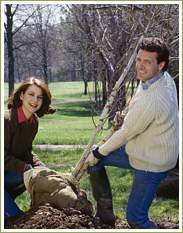 (NAPS)�DEAR DR. MOORE: Do you have any advice for starting a community tree planting program?
I do�but first, you might be
interested in these stats from the
National Academy of Sciences.
Did you know
that America�s
urban landscape
has an estimated
100 million potential
spots where
trees could be
planted and that
filling these spaces
could result in
annual energy savings
of 50 billion
kilowatt-hours, or a quarter of the
energy used to power all of the
country�s air conditioners? This
would reduce emissions of carbon
dioxide by 35 million tons and
save an estimated $3.5 billion in
electricity costs. Which is simply
to say�the more trees planted,
the greater the rewards.
To start, I�d suggest you do some
research. Call the forestry department
of your local government. If
your community already has an
established tree planting program,
find out how extensive it is and
whether you can be involved.
If it doesn�t, the National Arbor
Day Foundation (
www.arborday.org) has a program called Tree
City USA, which is sponsored in
cooperation with the USDA Forest
Service and the National Association
of State Foresters. Together,
these groups offer a wealth of
resources and technical advice.
Perhaps you can work through
them to help your community
become a "tree city".
On the other hand, you may
have a particular site in mind and
simply want permission and
resources. If it�s in a park or on a
street, talk to the forestry department.
Many communities have
partnership programs but some
want assurances that their partners
will commit to long-term care
and maintenance of the trees
planted.
If it�s on school property, talk to
the principal. He or she may be
excited by the prospect both of
making the grounds more beautiful
and creating a positive "tree
planting" event for students.
Depending on the school, a particular
department may also be willing
to take on tree maintenance as
a way to teach students about
forests and plant biology.
We�re lucky that in North
America, we have about the
same amount of forested land as
we did 100 years ago, because we
live in a society that places a
high priority on sustainable forest
management. But trees are
just as important in urban environments.
They offer shade in
summer and protection from the
wind in winter. They clean the
air, provide food and habitat for
wildlife and increase property
values. In fact, they benefit communities
in so many ways that it
just makes sense to plant as
many as possible.

 home
home