The Sensible Environmentalist
Forest Pests a Major Threat to Ecosystems
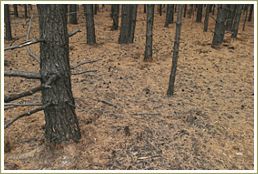 (NAPS)�DEAR DR. MOORE: I keep seeing forests that have turned brown from some kind of infestation. Is this common?
Unfortunately, yes. According
to the US Forest Service, about 70
million acres are "at
serious risk of being
wiped out by 26
insects and diseases,"
some of
which are native
and some of which
are introduced.
You�ve seen the
impacts. Those
brown forests represent a heartbreaking
loss of biodiversity, not to
mention cultural heritage. Thanks
to Dutch elm disease, for example,
the American elm has all but disappeared
from the urban landscape,
and white pine blister rust has
pretty well obliterated the western
white pine and American chestnut.
It�s been described as "catastrophic
wildfire in slow motion,"
the way an infestation spreads
across the landscape, killing an
entire forest. And, as with fire, the
best way to protect native forests is
to prevent the pests from taking
hold. Part of this includes actively
managing our forests�by removing
dead wood and undergrowth, and
thinning the trees�to keep them
healthy and able to resist attack.
The US Forest Service has a
four-pronged strategy that begins
with prevention, which makes
sense, given that control efforts
and economic damages are estimated
to cost the US $137 billion
every year. But consider the challenge.
Most exotic pests are introduced
unintentionally, with many
arriving on plants imported for
landscaping. They tend to be
small, similar in color to the plant
and have the ability to hide in
wood, roots or buds. Widespread
container use and the fact that
inspectors only examine about two
percent of all arriving cargo,
makes detection even tougher.
Because of these challenges,
the US is going to great lengths to
improve monitoring so it can
respond to infestations quickly.
Unfortunately, it doesn�t always
work.
Take the hemlock woolly adelgid,
which was first reported in
British Columbia in 1924 and not
seen again until 1950 when it was
found in Virginia. No one suspected
its potential for destruction,
so nothing was done to contain
it�and the woolly adelgid is
now the single greatest threat to
hemlock in the eastern US.
It�s maddening to see forests
lost to insects and disease, just
like it�s maddening to see them
lost to fire. The most sensible
approach is to improve monitoring
and early response and to manage
our forests in a way that helps
them resist infestation.

 home
home